



- Login
- Register


News
The latest updates from COMOON. Stay tuned to not miss any information!
DESICCATED COCONUT: EVERYTHING YOU NEED TO KNOW ABOUT QUALITY STANDARDS, PROCESSING, AND APPLICATIONS
Thursday, 05/11/2026, 07:16
Desiccated coconut is a widely used ingredient in the food industry thanks to its natural rich flavor, low moisture content, and long shelf life. Available in various sizes and fat content specifications, it meets diverse needs across confectionery, ready-to-eat food production, the F&B industry, and export markets. So, what is desiccated coconut, what types are available, what technical standards must it meet, and how is it used in food processing? Let’s explore these topics in detail with COMOON in the following article.
What is desiccated coconut?
Desiccated coconut is a product made from mature coconut meat that has been removed from the shell, cleaned, grated or cut into the required sizes, and then dried to remove most of its moisture. This process extends the product's shelf life while preserving its characteristic coconut aroma and rich flavor.
Unlike fresh coconut meat, which has a high moisture content and a relatively short shelf life, desiccated coconut has a low moisture content, making it easier to store, transport, and distribute in international markets. It is also a suitable ingredient for food production lines that require precise measurement and blending of dry ingredients.
Raw materials for desiccated coconut production
The quality of desiccated coconut largely depends on the maturity of the coconuts, fat content, and quality of the raw coconut meat. In industrial production, mature coconuts are generally preferred because they have thick, firm meat, a naturally high oil content, and a distinctive coconut flavor.

Ben Tre coconut plantations
In Vietnam, Ben Tre is widely recognized as one of the country's leading coconut-growing regions, supplying a major source of coconuts for food processing and export.
COMOON desiccated coconut is made from 100% selected mature coconut meat that meets quality standards and is sourced from the Ben Tre raw material region. The raw materials undergo a closed-loop preliminary treatment and processing process, with moisture content, fat content, and particle size carefully controlled to maintain consistent quality across batches.

Why is drying technology used in desiccated coconut production?
Drying is an essential stage in desiccated coconut processing, helping remove most of the moisture from the raw material. Reducing moisture content helps limit conditions favorable for microbial growth, thereby extending the product's shelf life and usability.
For coconut meat, the drying process requires appropriate temperature and time control to minimize the impact on its natural color, aroma, and fat quality. After drying, the product is cooled, graded according to particle size, and tested against technical specifications before packaging.
One of the key advantages of desiccated coconut is its versatility. Businesses can choose finely grated coconut for blending into flour mixtures or sliced and shredded varieties for decorating cakes and desserts, without requiring an additional moisture-removal process.
Technical Standards for Desiccated Coconut
Technical specifications are an important basis for importers and food manufacturers to evaluate raw material quality before selecting a supplier. Below are the key quality criteria to consider when sourcing desiccated coconut.
Sensory standards
High-quality desiccated coconut should have a natural white color, without any signs of unusual discoloration. It should retain the characteristic coconut aroma and natural rich flavor, with no foreign odors or off-flavors.
In addition, the particle size, flakes, or shreds must meet the specified order requirements. Uniformity in the finished product makes the ingredient easier to blend and helps maintain consistent quality throughout the production process.
Fat content standards
Fat content is an important specification that affects the richness, flavor, and functional properties of desiccated coconut in food formulations.
Depending on production requirements, the product can be classified into three categories:
|
Classification |
Fat content |
|
High Fat |
≥ 63%, depending on specifications |
|
Medium Fat |
45%–55% |
|
Low Fat |
≥ 35% |

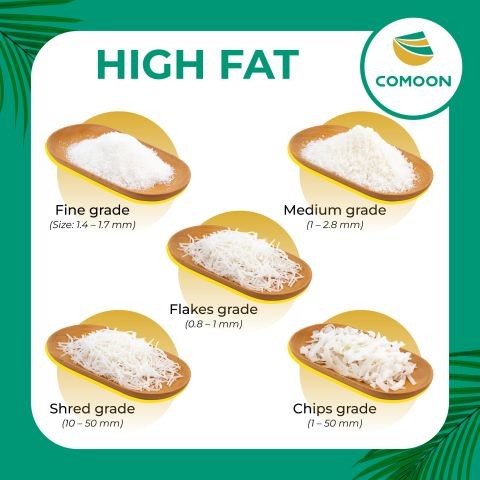
COMOON High Fat Desiccated Coconut
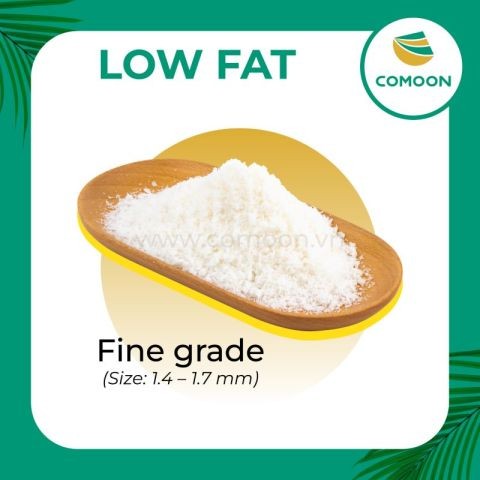
COMOON Low Fat Desiccated Coconut
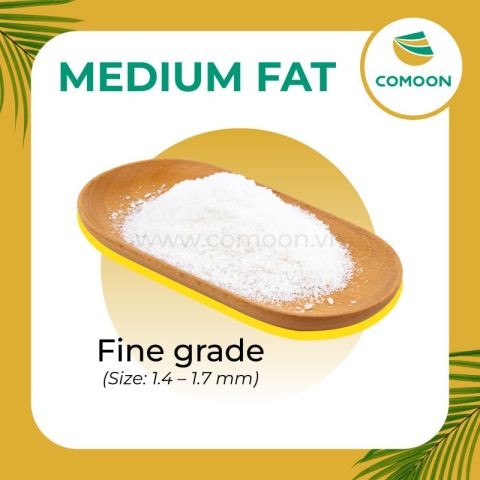
COMOON Medium Fat Desiccated Coconut
Products with higher fat content are generally preferred for applications that require a rich coconut flavor and natural creaminess. Meanwhile, Medium Fat and Low Fat varieties are suitable for formulations that require specific fat content levels to meet finished product requirements.
Moisture content and FFA standards
Moisture content and FFA (Free Fatty Acids) are two important parameters that must be controlled during production and storage.
According to COMOON's desiccated coconut product specifications:
-
Moisture content: Maximum 3%.
-
FFA: Maximum 0.3%.
Low moisture content helps limit microbial growth and supports a longer shelf life. Meanwhile, controlling FFA helps assess fat stability and reduce the risk of rancid odors developing during storage.
Microbiological and food safety standards
For export products, microbiological and food safety parameters must be controlled in accordance with the regulations of the importing market. Businesses should pay attention to indicators such as total aerobic plate count, yeast, mold, and pathogenic microorganisms, as required by applicable standards.
In addition, controlling the risks of cross-contamination, foreign matter, and heavy metals during processing is essential to ensuring finished product quality. Importers should request quality documentation, relevant certifications, and batch-specific test reports from suppliers when necessary.
Desiccated coconut manufacturing process
To achieve the required standards for color, flavor, moisture content, and particle size, desiccated coconut must undergo several processing and quality control stages.
Step 1: Coconut Harvesting and Raw Material Selection
Coconuts are harvested when they reach the appropriate maturity, ensuring that the meat has the required thickness, fat content, and quality for production. Incoming raw materials are carefully selected to minimize the use of coconuts that do not meet the required standards.
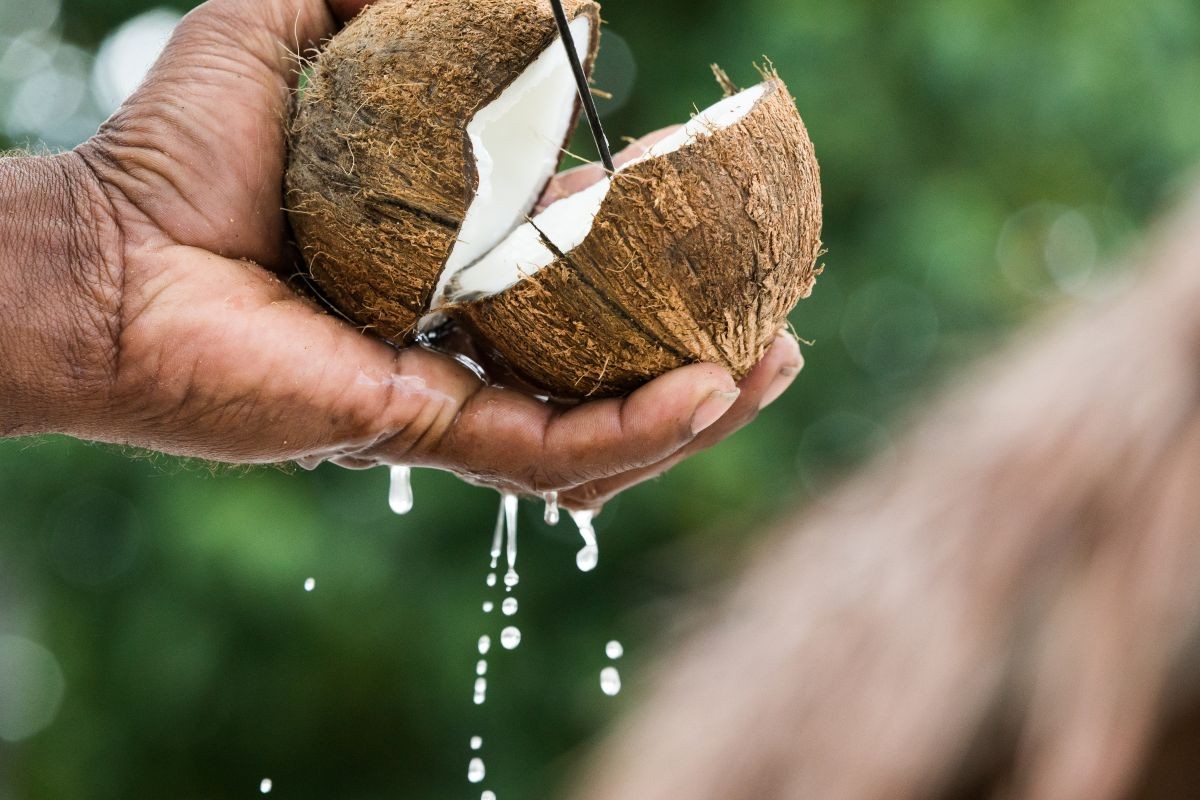
Coconuts at the appropriate maturity stage
Step 2: Coconut Meat Extraction and Cleaning
After removing the fibrous husk and hard shell, the white coconut meat is separated from the shell. The outer brown testa is then removed to ensure the desired color and quality of the raw material.
Step 3: Coconut Meat Cleaning
The coconut meat is thoroughly cleaned to remove any remaining impurities from the extraction process. The raw material is then inspected before proceeding to the grating or cutting stage.
Step 4: Grating and Shaping
Depending on the finished product requirements, the coconut meat is processed into various forms, including fine, medium, flakes, or shreds. Particle sizes are controlled for each product line to meet customer specifications.
Step 5: Drying
The raw material is fed into a drying system to remove most of its moisture. Drying temperature and time must be appropriately controlled to achieve a maximum finished product moisture content of 3%, while preserving the coconut's natural color and flavor.
Step 6: Cooling and Grading
After drying, the product is cooled before grading. This stage helps minimize moisture condensation inside the packaging and ensures that the finished product meets the required specifications for particle size and fat content across different product lines.
Step 7: Quality Inspection and Packaging
The finished product is tested against key specifications, including sensory characteristics, moisture content, FFA, fat content, and particle size. It is then packaged in 15 kg, 25 kg, 50 kg bags, or customized packaging according to customer requirements.
Step 8: Storage and Transportation
Finished desiccated coconut is stored in a cool, dry, and well-ventilated area at temperatures below 25°C. The product can be transported by sea or air to domestic and international markets.
Applications of desiccated coconut in industrial food production
Thanks to its natural rich flavor, low moisture content, and variety of particle sizes, desiccated coconut is used across various food processing sectors. Depending on the characteristics of the finished product, businesses can select suitable specifications to optimize their formulations and production processes.
OEM and private label ingredients
For OEM and Private Label orders, businesses typically require suppliers to maintain consistent quality and technical specifications across batches.
With various fat content levels, particle sizes, and packaging options, desiccated coconut allows partners to select ingredients that suit their own formulations. Controlling moisture content, FFA, and finished product size also helps ensure consistency throughout the manufacturing process.
Applications of desiccated coconut in F&B
Desiccated coconut is widely used in the F&B industry thanks to its natural coconut flavor, characteristic richness, and versatility in combination with various food products.
- Bakery & Confectionery: Used as an ingredient, filling, or topping for cookies, sponge cakes, chocolate, coconut candies, and cereal bars.
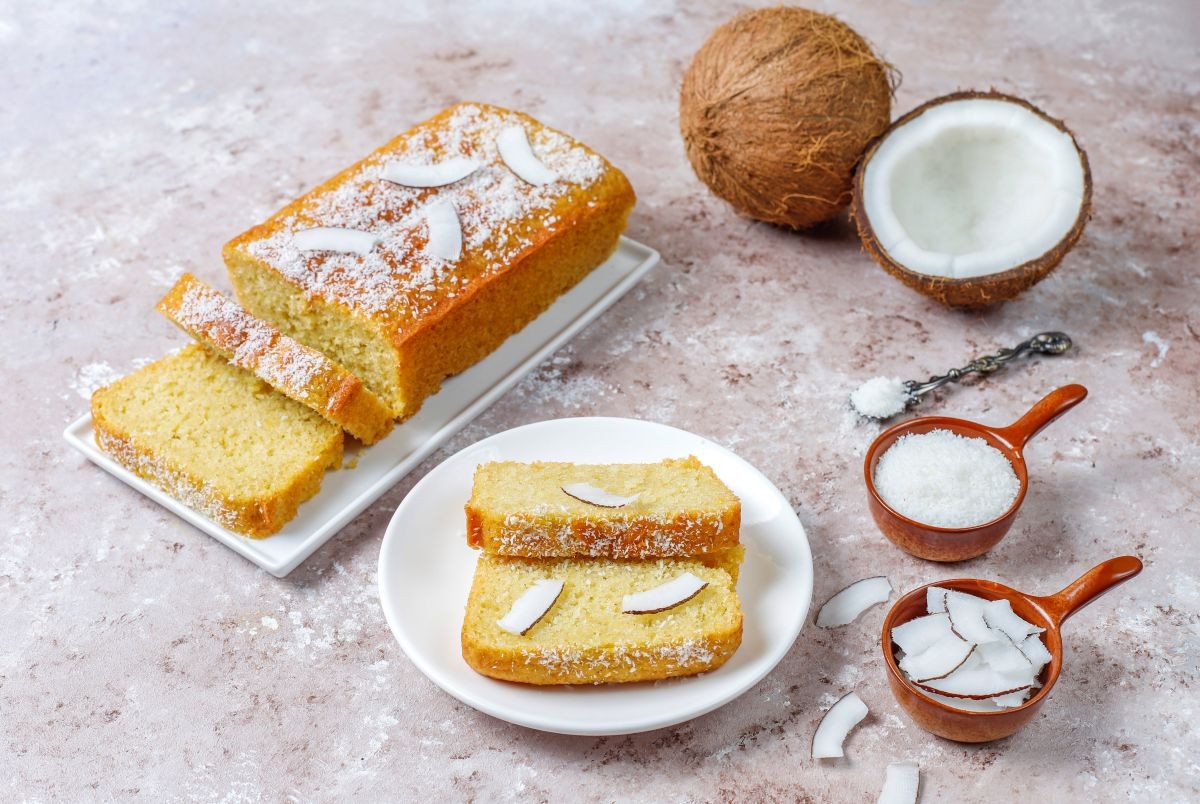
COMOON desiccated coconut sprinkled on sponge cake
Beverages: Used as a topping for milk tea, blended drinks, smoothies, drinkable yogurt, and various tropical beverages.
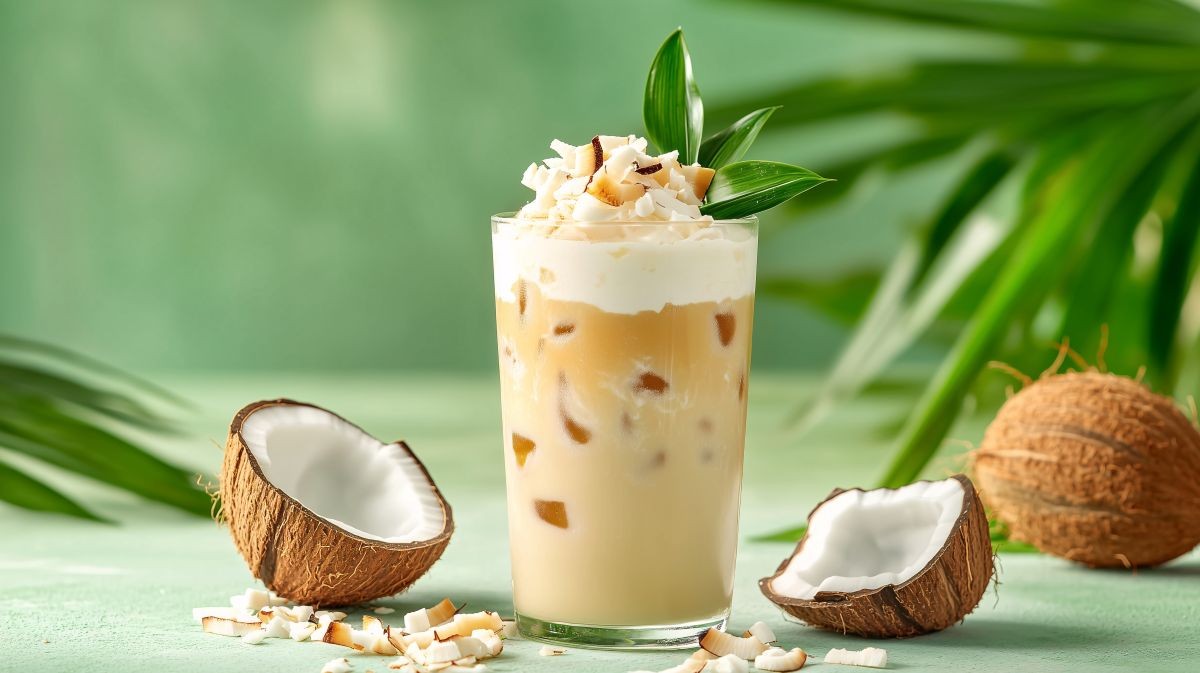
COMOON desiccated coconut as a milk tea topping
- Desserts: Combined with ice cream, pudding, panna cotta, Vietnamese sweet soups, yogurt, and fruit-based desserts.
- Food Processing: Used in coconut-crusted fried shrimp, coconut-crusted fried chicken, salads, granola, cereals, and snacks.
With a variety of specifications, including Fine, Medium, and Low Fat, COMOON desiccated coconut flexibly meets the processing needs of restaurants, cafés, bakeries, and food manufacturers. It helps diversify product offerings while adding value to Vietnamese coconut ingredients.
Desiccated coconut in international cuisine
Coconut meat is a familiar ingredient in the cuisines of many countries, particularly across Southeast Asia, South Asia, the Middle East, and Europe. With its naturally rich flavor and versatile textures, desiccated coconut can be used in a wide range of baked goods, breakfast dishes, and modern processed foods.
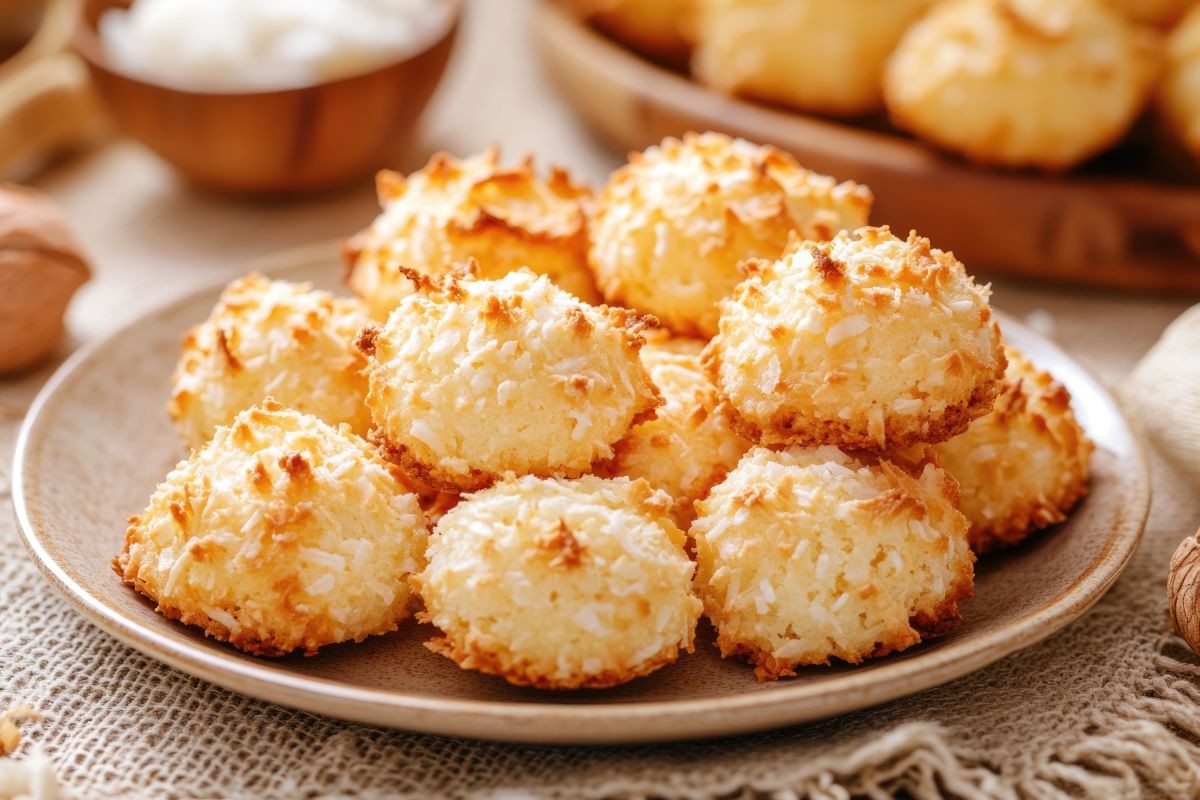
Coconut cookies
Thread or Fine desiccated coconut is mixed with egg whites, sugar, and vanilla to create cookies with a lightly golden exterior, a soft and chewy texture, and a rich coconut flavor.
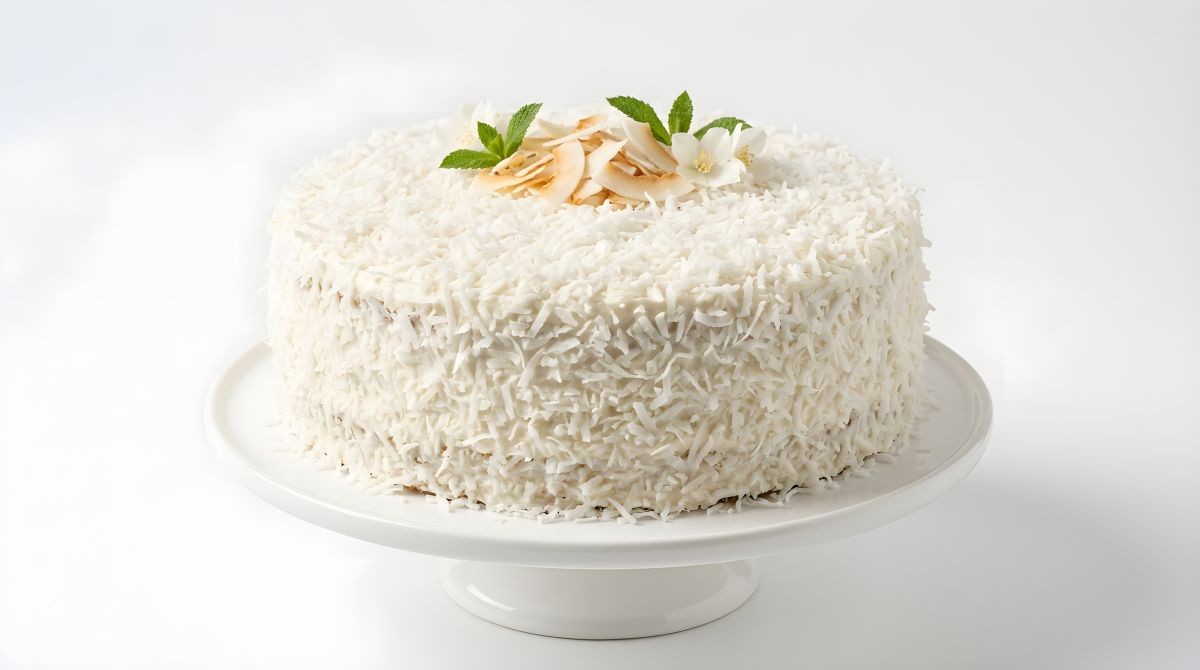
Cake topped with COMOON desiccated coconut
Desiccated coconut can be incorporated into cake batter or used as a decorative topping, enhancing the aroma and richness while adding an appealing texture to every layer of the cake.
Chip or Thread desiccated coconut is combined with oats, almonds, cashews, and honey before baking. The result is a crispy, fragrant mixture commonly served with fresh milk, yogurt, or fruit.
Fine or Thread desiccated coconut is used as a filling, coating, or blending ingredient in chocolate products. The combination of chocolate's sweetness and coconut's natural richness creates an appealing product with a diverse flavor profile.
Where to buy desiccated coconut?
In Vietnam, COMOON supplies desiccated coconut to both domestic and international markets. The product is made from 100% selected mature fresh coconut meat sourced from the Ben Tre raw material region.
COMOON desiccated coconut is available in various product lines based on fat content and particle size, including High Fat, Medium Fat, and Low Fat, with Fine, Medium, Chip, and Thread varieties.
The product has a maximum moisture content of 3% and a maximum FFA of 0.3%. It is available in 15 kg, 25 kg, and 50 kg packaging, or customized according to customer requirements. The shelf life is 12 months under appropriate storage conditions.
Why choose COMOON desiccated coconut?
Ben Tre coconut raw materials: COMOON uses 100% selected mature fresh coconut meat sourced from the Ben Tre raw material region, ensuring clear origin and consistent incoming raw material quality.
Processing and export experience: COMOON is a member company of HungHau Foods Joint Stock Company (HungHau Foods), with over 10 years of experience in domestic and international agricultural processing and exports.
Diverse product specifications: High Fat, Medium Fat, and Low Fat product lines, available in Fine, Medium, Chip, and Thread varieties, flexibly meet the production requirements of different partners.
International standards and certifications: The factory and products meet the standards and certifications announced by COMOON, including BRCGS, FSSC 22000, SGS, HALAL, and FDA.
Stable supply and competitive pricing: COMOON is committed to maintaining product availability and consistent quality, along with preferential pricing for direct orders. This helps partners optimize raw material costs and improve production and business efficiency.
Businesses preparing production plans can contact COMOON to request samples and detailed technical specifications, helping them select products that best meet their actual requirements.
Frequently asked questions
1. How long can desiccated coconut be stored?
COMOON desiccated coconut has a shelf life of 12 months when stored properly in a cool, dry, and well-ventilated area at temperatures below 25°C.
2. What types of desiccated coconut are available?
Products are classified into three groups based on fat content: High Fat (Thread), Medium Fat (small flakes), and Low Fat (Fine). In addition, based on particle size and form, products are available in Fine, Medium, Chip, and Thread varieties.
3. Does desiccated coconut need to be refrigerated?
No. The product can be stored at room temperature below 25°C in a cool, dry, and well-ventilated area, away from direct sunlight.
4. Can desiccated coconut be consumed directly?
Yes. Depending on the recipe, desiccated coconut can be used directly as a topping, blended with cereals, or incorporated into various confectionery and food processing applications.
5. Does desiccated coconut contain preservatives?
The use of additives or preservatives should be verified against the ingredient declaration and technical documentation of each product. Low moisture content is one of the factors that helps extend the product's shelf life.
6. Is desiccated coconut suitable for vegetarian and vegan diets?
Desiccated coconut is plant-based and suitable for use in many vegetarian and vegan food recipes. For specific Vegan requirements, businesses should also check the ingredients and potential cross-contamination risks during production.
7. Which industries use desiccated coconut?
The product is used in confectionery, baked goods, chocolate, cereals, nutrition bars, ready-to-eat foods, and the F&B industry.
8. Can businesses order desiccated coconut in customized specifications?
Yes. COMOON offers various product sizes and fat content levels. Packaging is available in 15 kg, 25 kg, and 50 kg options, or can be customized according to customer requirements.
Desiccated coconut is a highly versatile ingredient in the food industry thanks to its natural rich flavor, low moisture content, and convenient storage properties. Choosing a reputable supplier that meets technical specifications and maintains a stable supply helps businesses manage their production, processing, and export operations more effectively.
With the advantage of sourcing coconut raw materials from Ben Tre, HungHau Foods' processing and export experience, and competitive pricing policies, COMOON aims to become a reliable supply partner, supporting businesses in bringing Vietnamese coconut products closer to global markets.
Contact information
COMOON COMPANY LIMITED
-
Phone: +84 366 053 666
-
Email: info@comoon.vn
-
Website: https://comoon.vn
Share :
Customer comments
Other news
COMOON Co., Ltd.
58 Co Giang Street, Cau Ong Lanh Ward, District 1, Ho Chi Minh City, Vietnam
T: (+84) 366 053 666
- Business Registration No.: 0318171053
- Issued on November 17, 2023 by the Department of Planning and Investment of Ho Chi Minh City.

Copyright © 2024 COMOON


