



- Login
- Register

News
The latest updates from COMOON. Stay tuned to not miss any information!
WHY IS BEN TRE HOME TO THE BEST-TASTING COCONUTS IN VIETNAM?
Friday, 27/03/2026, 08:04
Mục lục [Ẩn/Hiện]
- Unique Natural Conditions That Enhance the Quality of Ben Tre Coconuts
- Generational Farming Expertise from the “Land of Coconuts”
- Organic Farming and Clean Raw Material Zones
- Quality Indicators That Differentiate Ben Tre Coconuts
- International Recognition of the “Ben Tre Coconut” Brand
- A Diversified Coconut Product Ecosystem
- Conclusion
Coconut trees have long been deeply intertwined with Vietnamese life, especially in the Mekong Delta provinces. Beyond being a familiar part of daily living, coconuts serve as a key raw material for the food, cosmetics, and agricultural export industries. Among Vietnam’s coconut growing regions, Ben Tre is widely regarded as the cradle of the country’s coconut sector.
Ben Tre (now administratively merged into Vinh Long Province) is located in the Mekong Delta and is often referred to as the “Coconut Capital” of Vietnam. The province has nearly 79,000 hectares of coconut plantations, accounting for approximately 44–47% of the nation’s total coconut growing area. Thanks to the combined efforts of farmers and enterprises, Ben Tre coconut products are exported to more than 80 countries, generating nearly USD 500 million annually.
Unique Natural Conditions That Enhance the Quality of Ben Tre Coconuts
A River-Islet Geography at the Final Gateway of the Mekong
Ben Tre lies at the final gateway of the Mekong River before it flows into the sea. As part of the Mekong Delta, it consists of three major islets—An Hoa, Bao, and Minh—formed over time by alluvial deposits from four branches of the Mekong River: the Tien, Ba Lai, Ham Luong, and Co Chien rivers.
This distinctive alluvial–saline–acidic soil profile is rich in organic matter, minerals, and beneficial microorganisms. Such a soil composition provides ideal growing conditions for coconut trees. The harmonious combination of freshwater alluvium from upstream and mild natural salinity from the sea enables coconut palms to absorb minerals in a balanced manner, resulting in coconuts with a naturally sweet, delicate flavor and stable quality compared to many other growing regions.
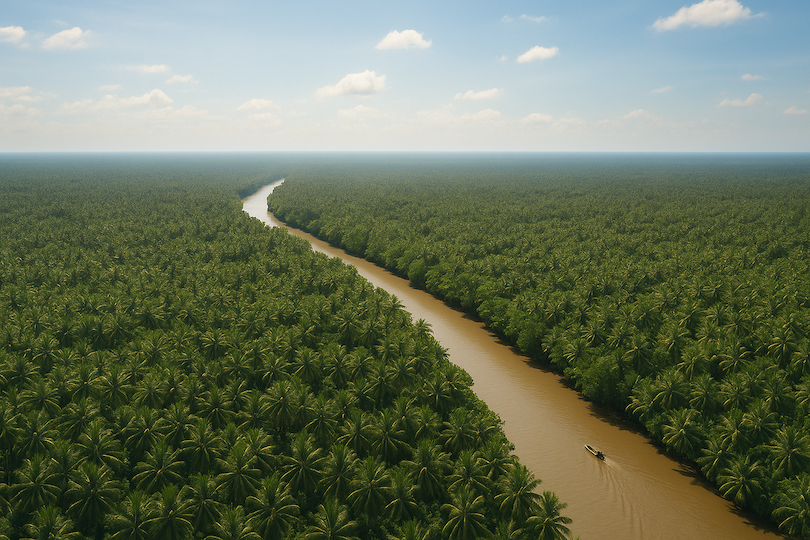
Ben Tre coconuts are located at the final gateway of the Mekong River (Source: Internet)
Tropical Monsoon Climate with Optimal Rainfall and Sunshine
Ben Tre features a humid tropical monsoon climate with an average annual temperature of approximately 27°C (ranging between 25–29°C), annual rainfall of 1,200–1,600 mm, and long sunshine hours. These climatic conditions are highly favorable for healthy coconut growth while limiting pest and disease pressures.
The relatively stable climate throughout the year ensures consistent coconut flavor profiles. Ben Tre coconut water maintains its natural sweetness and distinctive aroma with minimal seasonal variation, supporting uniform quality in processed coconut products.
Brackish Water and Natural Salinity Suitable for Coconut Cultivation
As a coastal brackish water region, Ben Tre experiences moderate natural saline intrusion. The combination of freshwater sediments from the Mekong and light seawater salinity allows coconut trees to absorb minerals in a balanced manner.
As a result, the Brix level of Ben Tre coconut water typically ranges from 5–9%, higher and more stable than in many strictly freshwater coconut growing regions. This is a critical factor contributing to its characteristic light sweetness, clean aftertaste, and smooth drinkability.
Generational Farming Expertise from the “Land of Coconuts”
Coconut cultivation in Ben Tre is not only supported by favorable natural conditions but also by generations of accumulated farming knowledge. The coconut tree is deeply embedded in local culture and daily life from thatched coconut leaf roofs and coconut wood bridges to coconut ladles and household utensils. It appears in folk poetry and historical narratives and has long been a primary source of income for local families.
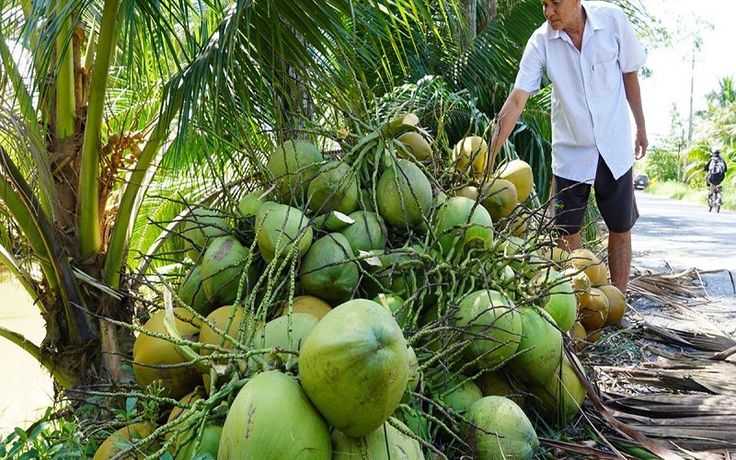
Local farmers harvesting coconuts (Source: Internet)
Over time, farmers have refined techniques in seed selection, irrigation management, nutrient balance, and optimal harvesting timing to ensure consistent fruit quality. Today, Ben Tre has developed a robust coconut processing ecosystem, producing desiccated coconut, coconut milk, coconut water, activated charcoal from coconut shells, and coconut-based handicrafts.
The integration of natural advantages, traditional knowledge, and industrial investment has created a sustainable value chain, reinforcing Ben Tre’s role as the backbone of Vietnam’s coconut industry.
Organic Farming and Clean Raw Material Zones
In recent years, Ben Tre has oriented its agricultural development toward organic and sustainable practices, with coconuts identified as a strategic crop. Under the Provincial Organic Agriculture Development Plan (2022–2025, with orientation to 2030), the province focuses on establishing certified clean coconut growing areas linked closely with farmers, cooperatives, and enterprises to meet export standards for demanding markets such as the United States, the European Union, and Japan.
Currently, more than 20,700 hectares of coconut plantations participate in organized value chains, of which over 16,500 hectares have achieved organic certification. These plantations are distributed across districts such as Binh Dai, Giong Trom, Mo Cay Nam, Mo Cay Bac, Thanh Phu, and Ba Tri.
Farmers increasingly replace chemical fertilizers and pesticides with organic compost, microbial solutions, and biological pest control methods. The use of Trichoderma fungi and parasitic wasps to control black headed caterpillars has significantly restored affected plantations while protecting the ecological balance.
Traceability systems, planting area codes, and packaging facility codes have been implemented comprehensively, enabling Ben Tre coconuts to meet stringent international technical barriers.
Quality Indicators That Differentiate Ben Tre Coconuts
Coconut Meat Fat Content and Coconut Water Sweetness
Traditional varieties such as “dua ta” and “dua dau” are known for thick, smooth coconut meat with stable natural oil content—ideal for coconut milk, virgin coconut oil, and export-oriented food processing. The alluvial brackish soil conditions contribute to superior fat content, low fiber, and high oil extraction yield.
Meanwhile, coconut water varieties such as “dua xiem” and “dua dua” exhibit natural Brix levels of 5–9%, delivering a light sweetness and clean aftertaste. This stable sweetness reduces the need for formula adjustments during processing and aligns with clean label and no added sugar trends in global markets.
International Recognition of the “Ben Tre Coconut” Brand
Over the years, Ben Tre has built a strong international reputation based on stable quality and production capacity. More than 100 coconut based products are exported to over 100 countries and territories across Asia, Europe, the Americas, Oceania, and Africa.
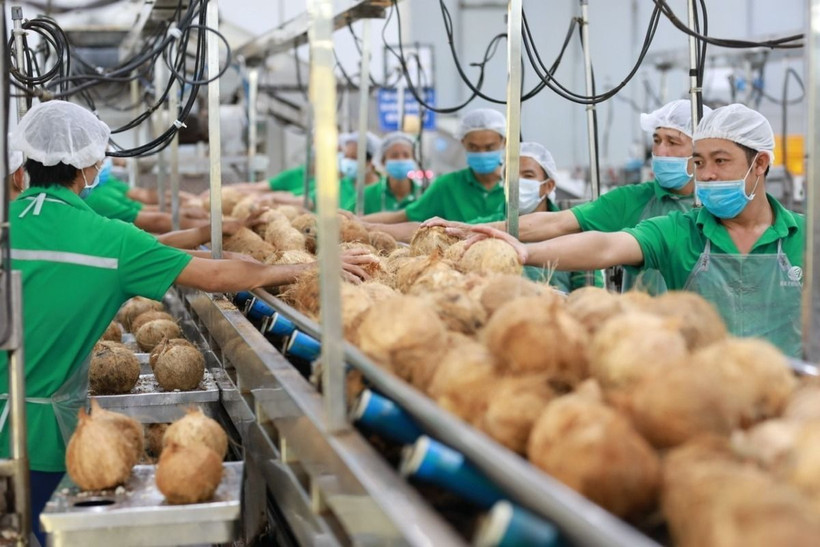
Coconut products from Ben Tre are exported to over 100 countries and territories (Source: Internet)
Coconut and coconut based products generate over USD 390 million annually (as of 2024), ranking among Vietnam’s key agricultural export commodities. In the first nine months alone, 22 million fresh coconuts were exported to demanding markets such as the United States, Japan, the European Union, and South Korea—markets that impose strict requirements on food safety, traceability, and residue standards.
A Diversified Coconut Product Ecosystem
Ben Tre has developed a comprehensive coconut value ecosystem serving food, industrial, agricultural, and handicraft sectors. Products such as coconut shell bowls, desiccated coconut powder, coconut based artwork, and coir mats reflect the circular utilization philosophy of local communities, minimizing by-products and maximizing value.
Only high quality raw materials—meeting standards in sweetness, fat content, uniformity, and safety can support such diversified and long term export oriented production. This explains why Ben Tre coconuts are strategically selected by both domestic and international enterprises.
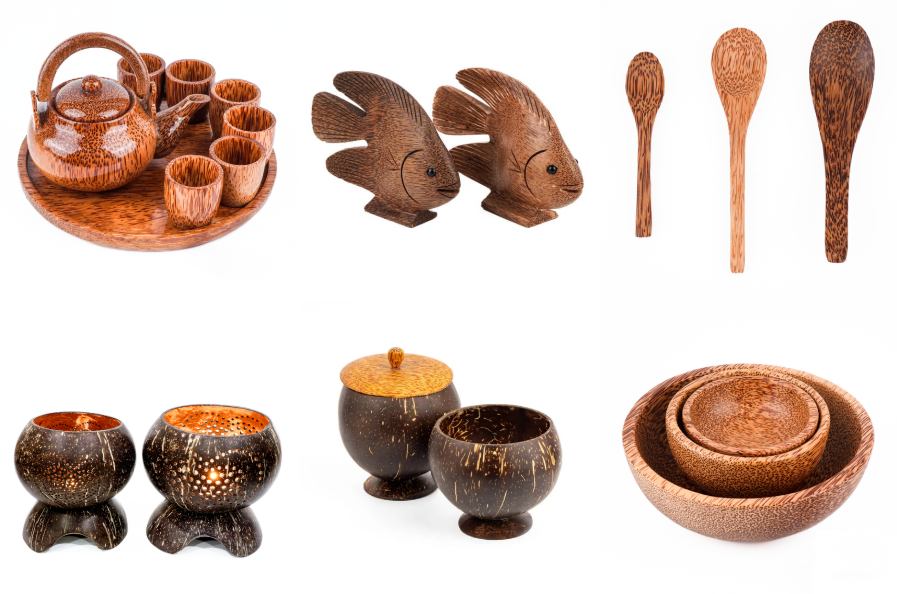
Coconut handicraft products from Ben Tre
Within this ecosystem, COMOON Co., Ltd. stands out as a representative enterprise effectively harnessing the value of Ben Tre coconuts. With a sustainable development orientation, the company focuses on high value added products, particularly COMOON fresh coconut water, sourced directly from Ben Tre coconuts.
Additionally, COMOON utilizes coconut by products to develop coir mats, coconut shell items, and coir ropes maximizing resource efficiency. With stable raw material sourcing and strict quality control processes, COMOON products are well received in the domestic market and are gradually expanding into international markets such as South Korea, where demand for natural, safe, and eco friendly products continues to rise.
Conclusion
Ben Tre possesses all the essential factors to be recognized as Vietnam’s premium coconut growing region. Its unique soil composition, stable climate, suitable brackish water conditions, generational farming expertise, and expanding organic production model collectively ensure high yields and superior quality.
Vietnamese enterprises, including COMOON Co., Ltd., are leveraging these natural and cultural advantages to develop coconut based products especially COMOON fresh coconut water—bringing consumers both domestically and internationally products that are naturally delicious, safe, and aligned with global consumption trends.
Share :
Customer comments
Other news
Subscribe to receive news
COMOON Co., Ltd.
727 3/2 Street, Dien Hong Ward, Ho Chi Minh City, Vietnam
T: (+84) 366 053 666
- Business Registration No.: 0318171053
- Issued on November 17, 2023 by the Department of Planning and Investment of Ho Chi Minh City.

Copyright © 2024 COMOON


